> ## Documentation Index
> Fetch the complete documentation index at: https://docs.theauth.dev/llms.txt
> Use this file to discover all available pages before exploring further.
# Shared Signals (SSF, CAEP, RISC)
> Send and receive security events between identity systems with the OpenID Shared Signals Framework 1.0, CAEP and RISC.
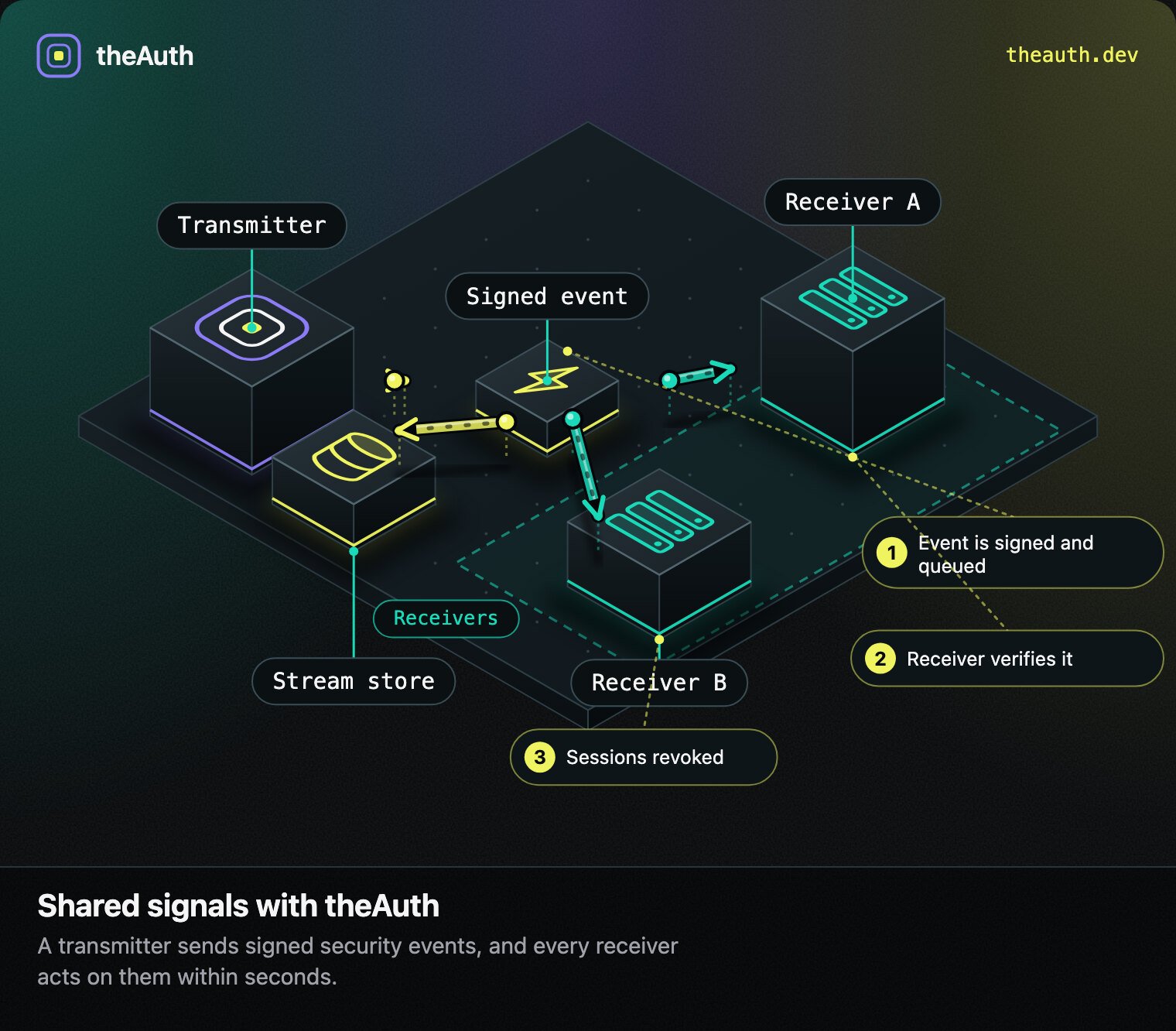
Shared signals let identity systems tell each other that something security relevant happened: a session was revoked, an account was disabled, a credential changed. theAuth implements the OpenID [Shared Signals Framework 1.0](https://openid.net/specs/openid-sharedsignals-framework-1_0.html) with the CAEP and RISC event types.
One plugin, `sharedSignals()`, can run either or both roles:
* **Transmitter.** Receivers create a stream, choose events and a delivery method, and theAuth sends them signed Security Event Tokens (SETs, RFC 8417).
* **Receiver.** theAuth verifies SETs from a transmitter you trust and runs handlers. By default it revokes local sessions when the transmitter says a session, all sessions, or an account is gone.
Nothing is emitted from your existing sign-in paths unless you wire it in (see [Emit from existing paths](#emit-from-existing-paths)).
 ## Why you would use it
Without shared signals, a disabled account in one system stays signed in everywhere else until each session expires. With them, the system that knows tells the others in seconds.
Ban a user once and every connected app drops their sessions.
Credential compromise or a device falling out of compliance can force re-authentication.
Interoperates with any SSF receiver or transmitter, not only theAuth.
Signed events, replay protection, SSRF-safe delivery, no events until you opt in.
## How it works
## Why you would use it
Without shared signals, a disabled account in one system stays signed in everywhere else until each session expires. With them, the system that knows tells the others in seconds.
Ban a user once and every connected app drops their sessions.
Credential compromise or a device falling out of compliance can force re-authentication.
Interoperates with any SSF receiver or transmitter, not only theAuth.
Signed events, replay protection, SSRF-safe delivery, no events until you opt in.
## How it works
 ## Try it in two steps
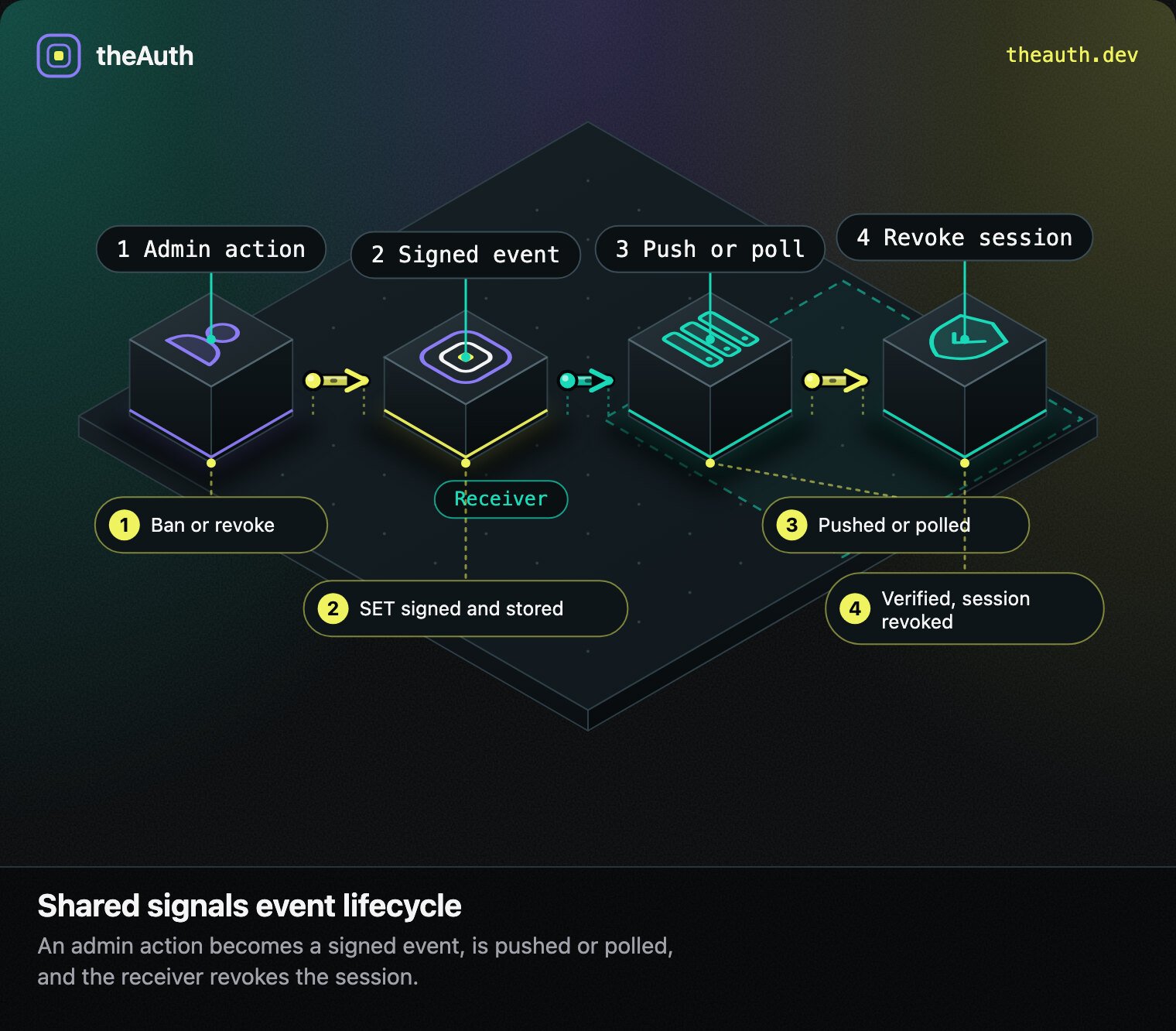
Add `sharedSignals({ transmitter })` and wire `bridge.onAdminAction` (see [Install](#install) and [Emit from existing paths](#emit-from-existing-paths)). Banning a user now emits `account-disabled` and `sessions-revoked`.
In the other app add `sharedSignals({ receiver: { issuer, audience } })` and register a stream with the transmitter pointing at `POST /ssf/receive`. Sessions for the banned user are revoked there with no extra code.
## Install
```ts theme={"dark"}
import { createTheAuth } from "@glinr/theauth";
import { sharedSignals } from "@glinr/theauth/signals";
const signals = sharedSignals({
transmitter: {
issuer: "https://auth.example.com",
endpointBaseUrl: "https://auth.example.com/api/auth/ssf",
signingKey: privateKey, // CryptoKey, JWK or Uint8Array
signingAlgorithm: "ES256",
keyId: "ssf-1",
jwksUri: "https://auth.example.com/.well-known/jwks.json",
authenticate: async (request) => {
const receiver = await lookupReceiverByBearer(request.headers.get("authorization"));
return receiver ? { id: receiver.audience } : null;
},
},
});
const theauth = await createTheAuth({
database: { provider: "sqlite", url: "theauth.db" },
plugins: [signals],
});
```
The plugin id is `theauth-shared-signals`. When it is present theAuth creates three tables: `theauth_ssf_streams`, `theauth_ssf_subjects` and `theauth_ssf_outbox`.
Publish the public key at `jwksUri` yourself. If you use the [OIDC provider](/auth/oidc-provider) with the same key, its JWKS endpoint already does.
## Transmitter
### Endpoints
Paths are relative to your mount path. `endpointBaseUrl` must be the absolute URL these are served at, because it is advertised in discovery.
| Method and path | Purpose |
| - | - |
| `GET /.well-known/ssf-configuration` | Discovery metadata. Needs your adapter to route the well-known path, as with OIDC discovery. |
| `POST /ssf/stream` | Create a stream. Returns 201. |
| `GET /ssf/stream` | Read one stream (`?stream_id=`) or list the caller's streams. |
| `PATCH /ssf/stream`, `PUT /ssf/stream` | Update or replace a stream. |
| `DELETE /ssf/stream?stream_id=` | Delete a stream. Returns 204. |
| `GET /ssf/status?stream_id=` | Read stream status. |
| `POST /ssf/status` | Set `enabled`, `paused` or `disabled`. |
| `POST /ssf/subjects/add`, `POST /ssf/subjects/remove` | Change the stream's subject list. |
| `POST /ssf/verify` | Ask for a verification event. Returns 204. |
| `POST /ssf/poll/:stream_id` | Poll a stream (RFC 8936). |
Every management and poll endpoint calls your `authenticate` function. A receiver only sees its own streams. Each endpoint declares a rate limit in its metadata.
### Streams
```json theme={"dark"}
{
"events_requested": [
"https://schemas.openid.net/secevent/risc/event-type/sessions-revoked",
"https://schemas.openid.net/secevent/risc/event-type/account-disabled"
],
"delivery": {
"method": "urn:ietf:rfc:8935",
"endpoint_url": "https://rp.example/ssf/receive",
"authorization_header": "Bearer shared-secret"
}
}
```
`events_delivered` is the intersection of `events_requested` and the events the transmitter supports. Delivery is `urn:ietf:rfc:8935` (push) or `urn:ietf:rfc:8936` (poll). For poll streams the response carries the poll URL in `delivery.endpoint_url`.
`authorization_header` is stored as given and is never returned.
### Subjects
Subject identifiers follow RFC 9493: `iss_sub`, `email`, `opaque` and `complex` (with `user`, `device`, `session`, `application`, `tenant`, `org_unit` and `group` members).
`defaultSubjects` sets the mode of new streams. With `ALL` (the default) every subject is delivered and `subjects/remove` excludes one. With `NONE` nothing is delivered until `subjects/add` includes a subject. A stream that follows a user also receives events whose complex subject has that user as its `user` member.
### Emitting events
```ts theme={"dark"}
import { events } from "@glinr/theauth/signals";
await signals.emit({
...events.accountDisabled({ reason: "hijacking" }),
subject: { format: "iss_sub", iss: "https://auth.example.com", sub: userId },
});
```
`emit` signs one SET per matching stream, stores it, and delivers it. Builders exist for every supported event:
| Builder | Event |
| - | - |
| `events.sessionRevoked` | CAEP session-revoked |
| `events.credentialChange` | CAEP credential-change |
| `events.tokenClaimsChange` | CAEP token-claims-change |
| `events.assuranceLevelChange` | CAEP assurance-level-change |
| `events.deviceComplianceChange` | CAEP device-compliance-change |
| `events.accountDisabled` | RISC account-disabled |
| `events.accountEnabled` | RISC account-enabled |
| `events.credentialCompromise` | RISC credential-compromise |
| `events.sessionsRevoked` | RISC sessions-revoked |
### Push delivery
## Try it in two steps
Add `sharedSignals({ transmitter })` and wire `bridge.onAdminAction` (see [Install](#install) and [Emit from existing paths](#emit-from-existing-paths)). Banning a user now emits `account-disabled` and `sessions-revoked`.
In the other app add `sharedSignals({ receiver: { issuer, audience } })` and register a stream with the transmitter pointing at `POST /ssf/receive`. Sessions for the banned user are revoked there with no extra code.
## Install
```ts theme={"dark"}
import { createTheAuth } from "@glinr/theauth";
import { sharedSignals } from "@glinr/theauth/signals";
const signals = sharedSignals({
transmitter: {
issuer: "https://auth.example.com",
endpointBaseUrl: "https://auth.example.com/api/auth/ssf",
signingKey: privateKey, // CryptoKey, JWK or Uint8Array
signingAlgorithm: "ES256",
keyId: "ssf-1",
jwksUri: "https://auth.example.com/.well-known/jwks.json",
authenticate: async (request) => {
const receiver = await lookupReceiverByBearer(request.headers.get("authorization"));
return receiver ? { id: receiver.audience } : null;
},
},
});
const theauth = await createTheAuth({
database: { provider: "sqlite", url: "theauth.db" },
plugins: [signals],
});
```
The plugin id is `theauth-shared-signals`. When it is present theAuth creates three tables: `theauth_ssf_streams`, `theauth_ssf_subjects` and `theauth_ssf_outbox`.
Publish the public key at `jwksUri` yourself. If you use the [OIDC provider](/auth/oidc-provider) with the same key, its JWKS endpoint already does.
## Transmitter
### Endpoints
Paths are relative to your mount path. `endpointBaseUrl` must be the absolute URL these are served at, because it is advertised in discovery.
| Method and path | Purpose |
| - | - |
| `GET /.well-known/ssf-configuration` | Discovery metadata. Needs your adapter to route the well-known path, as with OIDC discovery. |
| `POST /ssf/stream` | Create a stream. Returns 201. |
| `GET /ssf/stream` | Read one stream (`?stream_id=`) or list the caller's streams. |
| `PATCH /ssf/stream`, `PUT /ssf/stream` | Update or replace a stream. |
| `DELETE /ssf/stream?stream_id=` | Delete a stream. Returns 204. |
| `GET /ssf/status?stream_id=` | Read stream status. |
| `POST /ssf/status` | Set `enabled`, `paused` or `disabled`. |
| `POST /ssf/subjects/add`, `POST /ssf/subjects/remove` | Change the stream's subject list. |
| `POST /ssf/verify` | Ask for a verification event. Returns 204. |
| `POST /ssf/poll/:stream_id` | Poll a stream (RFC 8936). |
Every management and poll endpoint calls your `authenticate` function. A receiver only sees its own streams. Each endpoint declares a rate limit in its metadata.
### Streams
```json theme={"dark"}
{
"events_requested": [
"https://schemas.openid.net/secevent/risc/event-type/sessions-revoked",
"https://schemas.openid.net/secevent/risc/event-type/account-disabled"
],
"delivery": {
"method": "urn:ietf:rfc:8935",
"endpoint_url": "https://rp.example/ssf/receive",
"authorization_header": "Bearer shared-secret"
}
}
```
`events_delivered` is the intersection of `events_requested` and the events the transmitter supports. Delivery is `urn:ietf:rfc:8935` (push) or `urn:ietf:rfc:8936` (poll). For poll streams the response carries the poll URL in `delivery.endpoint_url`.
`authorization_header` is stored as given and is never returned.
### Subjects
Subject identifiers follow RFC 9493: `iss_sub`, `email`, `opaque` and `complex` (with `user`, `device`, `session`, `application`, `tenant`, `org_unit` and `group` members).
`defaultSubjects` sets the mode of new streams. With `ALL` (the default) every subject is delivered and `subjects/remove` excludes one. With `NONE` nothing is delivered until `subjects/add` includes a subject. A stream that follows a user also receives events whose complex subject has that user as its `user` member.
### Emitting events
```ts theme={"dark"}
import { events } from "@glinr/theauth/signals";
await signals.emit({
...events.accountDisabled({ reason: "hijacking" }),
subject: { format: "iss_sub", iss: "https://auth.example.com", sub: userId },
});
```
`emit` signs one SET per matching stream, stores it, and delivers it. Builders exist for every supported event:
| Builder | Event |
| - | - |
| `events.sessionRevoked` | CAEP session-revoked |
| `events.credentialChange` | CAEP credential-change |
| `events.tokenClaimsChange` | CAEP token-claims-change |
| `events.assuranceLevelChange` | CAEP assurance-level-change |
| `events.deviceComplianceChange` | CAEP device-compliance-change |
| `events.accountDisabled` | RISC account-disabled |
| `events.accountEnabled` | RISC account-enabled |
| `events.credentialCompromise` | RISC credential-compromise |
| `events.sessionsRevoked` | RISC sessions-revoked |
### Push delivery
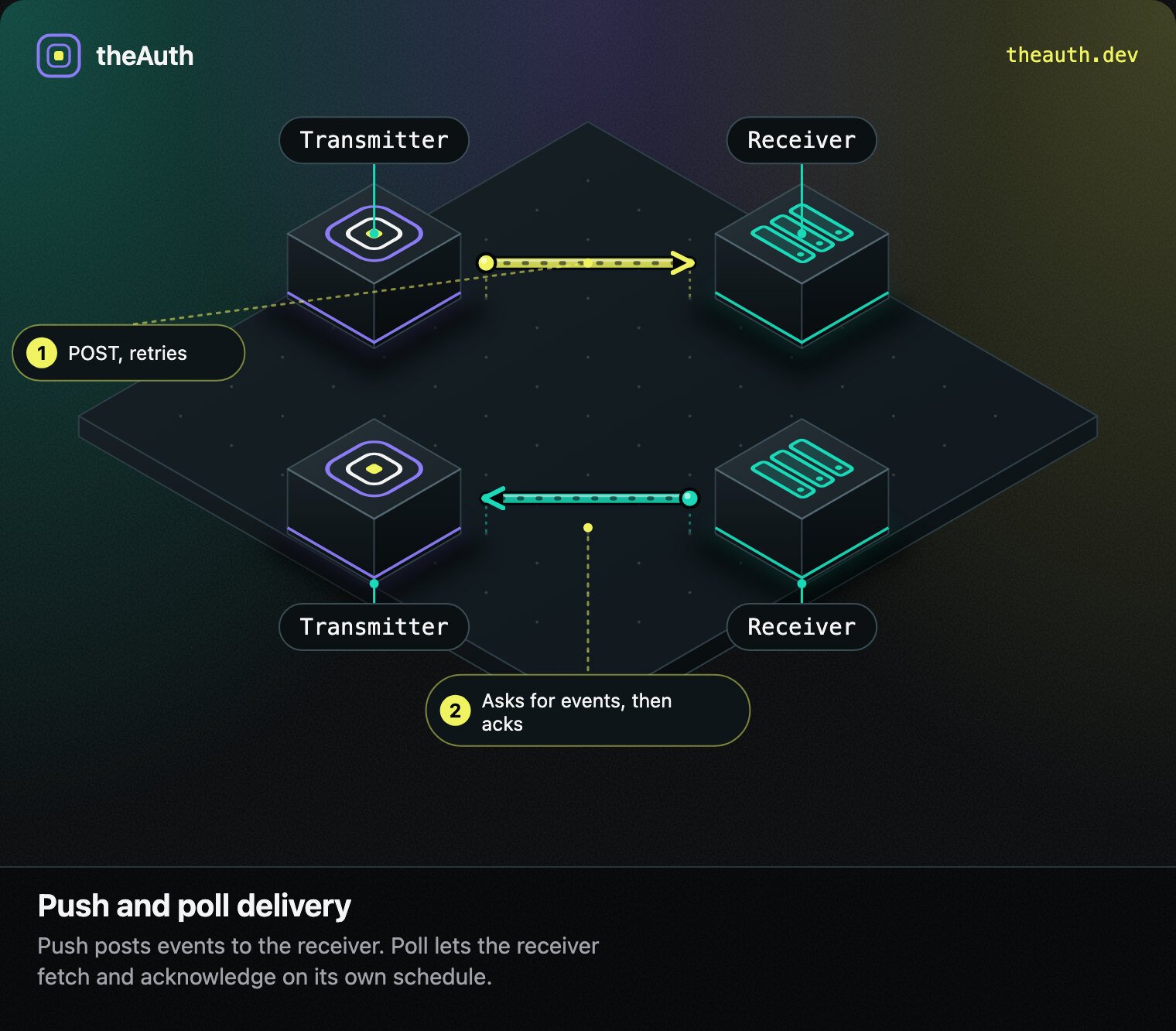 SETs are POSTed as `application/secevent+jwt` with the stream's `Authorization` header. A `2xx` marks the SET delivered. `408`, `429`, `5xx` and network errors are retried with exponential backoff (default 1 s doubling to 5 min, up to 5 attempts). Other statuses, including an RFC 8935 `400` error, and redirects fail the SET without retry.
Push URLs go through the same checks as other outbound fetches in theAuth: https only, no credentials, default port, no `localhost` or metadata hostnames, and every resolved address must be public. The check runs when the stream is configured and again before each attempt. Redirects are never followed.
`delivery` options:
| Option | Default | Meaning |
| - | - | - |
| `mode` | `background` | `inline` awaits delivery and retries inside `emit`. |
| `maxAttempts` | 5 | Attempts before a SET is marked failed. |
| `baseBackoffMs`, `maxBackoffMs` | 1000, 300000 | Backoff bounds. |
| `timeoutMs` | 5000 | Per request timeout. |
| `fetchImpl`, `resolver` | global fetch, system DNS | Overrides, for example to pin the connection to the validated address. |
| `allowInsecure` | false | Allow http and private hosts. Development only. |
Retries in `background` mode run on in-process timers. If the process exits, pending SETs stay in `theauth_ssf_outbox`; call `signals.transmitter.processDue()` from a scheduled job to resume them. Serverless runtimes that freeze after the response should use `inline` or run `processDue()` on a schedule.
### Poll delivery
`POST /ssf/poll/:stream_id` accepts `maxEvents`, `returnImmediately`, `ack` and `setErrs` and answers `{ "sets": { "": "" }, "moreAvailable": false }`. Unacknowledged SETs are returned again. `returnImmediately: false` waits up to `longPollMs` (default 0, so it answers at once).
## Receiver
```ts theme={"dark"}
const signals = sharedSignals({
receiver: {
issuer: "https://idp.example",
audience: "https://app.example",
// keys: discovered from the issuer's ssf-configuration by default
authorizationHeader: "Bearer shared-secret",
handlers: {
"https://schemas.openid.net/secevent/caep/event-type/credential-change": async (event) => {
await flagForReauth(event.subject);
},
},
},
});
```
The push endpoint is `POST /ssf/receive` (configurable with `path`). Keys come from, in order: `verificationKey`, a static `jwks`, or discovery. Discovery fetches `${issuer}/.well-known/ssf-configuration` (or `configurationUrl`), requires its `issuer` to equal the configured issuer, then fetches `jwks_uri`, all through the SSRF-safe fetcher. An unknown `kid` triggers at most one refetch every 30 seconds.
Checks on every SET: signature, `typ` of `secevent+jwt`, `iss`, `aud`, an `events` object, no `exp`, an `iat` no older than `maxAgeSeconds` (default 3600), and a `jti` not seen before. Replays are acknowledged with `202` and not dispatched again. Failures answer `400` with an RFC 8935 `err` such as `invalid_key`, `invalid_issuer` or `invalid_audience`.
The replay cache is per process memory by default. Pass `replayStorage` (any `SecondaryStorage`) when you run several instances.
### Default session revocation
When the app has a session manager, these events revoke local sessions unless you set `revokeSessions: false`:
| Event | Effect |
| - | - |
| session-revoked | Revokes the session when the subject is a `complex` subject with an opaque `session`. Otherwise revokes the user's sessions. |
| sessions-revoked | Revokes all sessions of the user. |
| account-disabled | Revokes all sessions of the user. It does not ban the account. Add a handler for that. |
User mapping: an `iss_sub` from the configured issuer maps `sub` to the local user id, an `email` is looked up in the user table, and an `opaque` id is taken as the user id. Pass `resolveUserId` to replace this. Handlers you supply take precedence over the defaults for the same event type.
## Emit from existing paths
The bridge turns existing callbacks into events. It is opt in: nothing is emitted until you pass the callback.
```ts theme={"dark"}
const signals = sharedSignals({ transmitter: { /* ... */ } });
const { bridge } = signals;
const theauth = await createTheAuth({
// session.onRevoke: session-revoked per revoked session
auth: { session: { onRevoke: bridge.onSessionsRevoked } },
// admin.onAdminAction: ban_user is account-disabled + sessions-revoked, unban_user is account-enabled
admin: { onAdminAction: bridge.onAdminAction },
// password reset: credential-change (password, update)
passwordReset: { /* ... */ onPasswordChanged: bridge.onPasswordChanged },
// 2FA and passkeys: credential-change create or delete
totp: { onChange: bridge.onTotpChange },
passkey: { /* ... */ onCredentialChange: bridge.onPasskeyChange },
plugins: [signals],
});
```
The callbacks are no-ops until the plugin has initialized, and they swallow errors so a receiver outage never blocks a sign-out or password change. The default subject is `iss_sub` with the transmitter issuer and the user id; pass `subjectForUser` to `sharedSignals` to change it.
## Limits
* Subject formats beyond `iss_sub`, `email`, `opaque` and `complex` (`account`, `phone_number`, `did`, `uri`, and so on) are rejected.
* Per-subject stream status is not supported (`501`). Subject `verified` is stored but not enforced.
* The stream-updated event is not sent.
* Streams are authorized by your `authenticate` function only. There is no built-in OAuth scope model for management calls.
* Delivery is at least once. Receivers should treat `jti` as an idempotency key.
* The platform `fetch` resolves the push hostname again when connecting, so a DNS rebinding attacker with a very short TTL can race the address check. Pass a `fetchImpl` that pins the validated address to close this.
* Database support follows the rest of the SDK: tables use the shared SQLite-style schema definitions.
This documentation is built and hosted on [Mintlify](https://mintlify.com), a developer documentation platform.
SETs are POSTed as `application/secevent+jwt` with the stream's `Authorization` header. A `2xx` marks the SET delivered. `408`, `429`, `5xx` and network errors are retried with exponential backoff (default 1 s doubling to 5 min, up to 5 attempts). Other statuses, including an RFC 8935 `400` error, and redirects fail the SET without retry.
Push URLs go through the same checks as other outbound fetches in theAuth: https only, no credentials, default port, no `localhost` or metadata hostnames, and every resolved address must be public. The check runs when the stream is configured and again before each attempt. Redirects are never followed.
`delivery` options:
| Option | Default | Meaning |
| - | - | - |
| `mode` | `background` | `inline` awaits delivery and retries inside `emit`. |
| `maxAttempts` | 5 | Attempts before a SET is marked failed. |
| `baseBackoffMs`, `maxBackoffMs` | 1000, 300000 | Backoff bounds. |
| `timeoutMs` | 5000 | Per request timeout. |
| `fetchImpl`, `resolver` | global fetch, system DNS | Overrides, for example to pin the connection to the validated address. |
| `allowInsecure` | false | Allow http and private hosts. Development only. |
Retries in `background` mode run on in-process timers. If the process exits, pending SETs stay in `theauth_ssf_outbox`; call `signals.transmitter.processDue()` from a scheduled job to resume them. Serverless runtimes that freeze after the response should use `inline` or run `processDue()` on a schedule.
### Poll delivery
`POST /ssf/poll/:stream_id` accepts `maxEvents`, `returnImmediately`, `ack` and `setErrs` and answers `{ "sets": { "": "" }, "moreAvailable": false }`. Unacknowledged SETs are returned again. `returnImmediately: false` waits up to `longPollMs` (default 0, so it answers at once).
## Receiver
```ts theme={"dark"}
const signals = sharedSignals({
receiver: {
issuer: "https://idp.example",
audience: "https://app.example",
// keys: discovered from the issuer's ssf-configuration by default
authorizationHeader: "Bearer shared-secret",
handlers: {
"https://schemas.openid.net/secevent/caep/event-type/credential-change": async (event) => {
await flagForReauth(event.subject);
},
},
},
});
```
The push endpoint is `POST /ssf/receive` (configurable with `path`). Keys come from, in order: `verificationKey`, a static `jwks`, or discovery. Discovery fetches `${issuer}/.well-known/ssf-configuration` (or `configurationUrl`), requires its `issuer` to equal the configured issuer, then fetches `jwks_uri`, all through the SSRF-safe fetcher. An unknown `kid` triggers at most one refetch every 30 seconds.
Checks on every SET: signature, `typ` of `secevent+jwt`, `iss`, `aud`, an `events` object, no `exp`, an `iat` no older than `maxAgeSeconds` (default 3600), and a `jti` not seen before. Replays are acknowledged with `202` and not dispatched again. Failures answer `400` with an RFC 8935 `err` such as `invalid_key`, `invalid_issuer` or `invalid_audience`.
The replay cache is per process memory by default. Pass `replayStorage` (any `SecondaryStorage`) when you run several instances.
### Default session revocation
When the app has a session manager, these events revoke local sessions unless you set `revokeSessions: false`:
| Event | Effect |
| - | - |
| session-revoked | Revokes the session when the subject is a `complex` subject with an opaque `session`. Otherwise revokes the user's sessions. |
| sessions-revoked | Revokes all sessions of the user. |
| account-disabled | Revokes all sessions of the user. It does not ban the account. Add a handler for that. |
User mapping: an `iss_sub` from the configured issuer maps `sub` to the local user id, an `email` is looked up in the user table, and an `opaque` id is taken as the user id. Pass `resolveUserId` to replace this. Handlers you supply take precedence over the defaults for the same event type.
## Emit from existing paths
The bridge turns existing callbacks into events. It is opt in: nothing is emitted until you pass the callback.
```ts theme={"dark"}
const signals = sharedSignals({ transmitter: { /* ... */ } });
const { bridge } = signals;
const theauth = await createTheAuth({
// session.onRevoke: session-revoked per revoked session
auth: { session: { onRevoke: bridge.onSessionsRevoked } },
// admin.onAdminAction: ban_user is account-disabled + sessions-revoked, unban_user is account-enabled
admin: { onAdminAction: bridge.onAdminAction },
// password reset: credential-change (password, update)
passwordReset: { /* ... */ onPasswordChanged: bridge.onPasswordChanged },
// 2FA and passkeys: credential-change create or delete
totp: { onChange: bridge.onTotpChange },
passkey: { /* ... */ onCredentialChange: bridge.onPasskeyChange },
plugins: [signals],
});
```
The callbacks are no-ops until the plugin has initialized, and they swallow errors so a receiver outage never blocks a sign-out or password change. The default subject is `iss_sub` with the transmitter issuer and the user id; pass `subjectForUser` to `sharedSignals` to change it.
## Limits
* Subject formats beyond `iss_sub`, `email`, `opaque` and `complex` (`account`, `phone_number`, `did`, `uri`, and so on) are rejected.
* Per-subject stream status is not supported (`501`). Subject `verified` is stored but not enforced.
* The stream-updated event is not sent.
* Streams are authorized by your `authenticate` function only. There is no built-in OAuth scope model for management calls.
* Delivery is at least once. Receivers should treat `jti` as an idempotency key.
* The platform `fetch` resolves the push hostname again when connecting, so a DNS rebinding attacker with a very short TTL can race the address check. Pass a `fetchImpl` that pins the validated address to close this.
* Database support follows the rest of the SDK: tables use the shared SQLite-style schema definitions.
This documentation is built and hosted on [Mintlify](https://mintlify.com), a developer documentation platform.