> ## Documentation Index
> Fetch the complete documentation index at: https://docs.theauth.dev/llms.txt
> Use this file to discover all available pages before exploring further.
# MCP Authorization
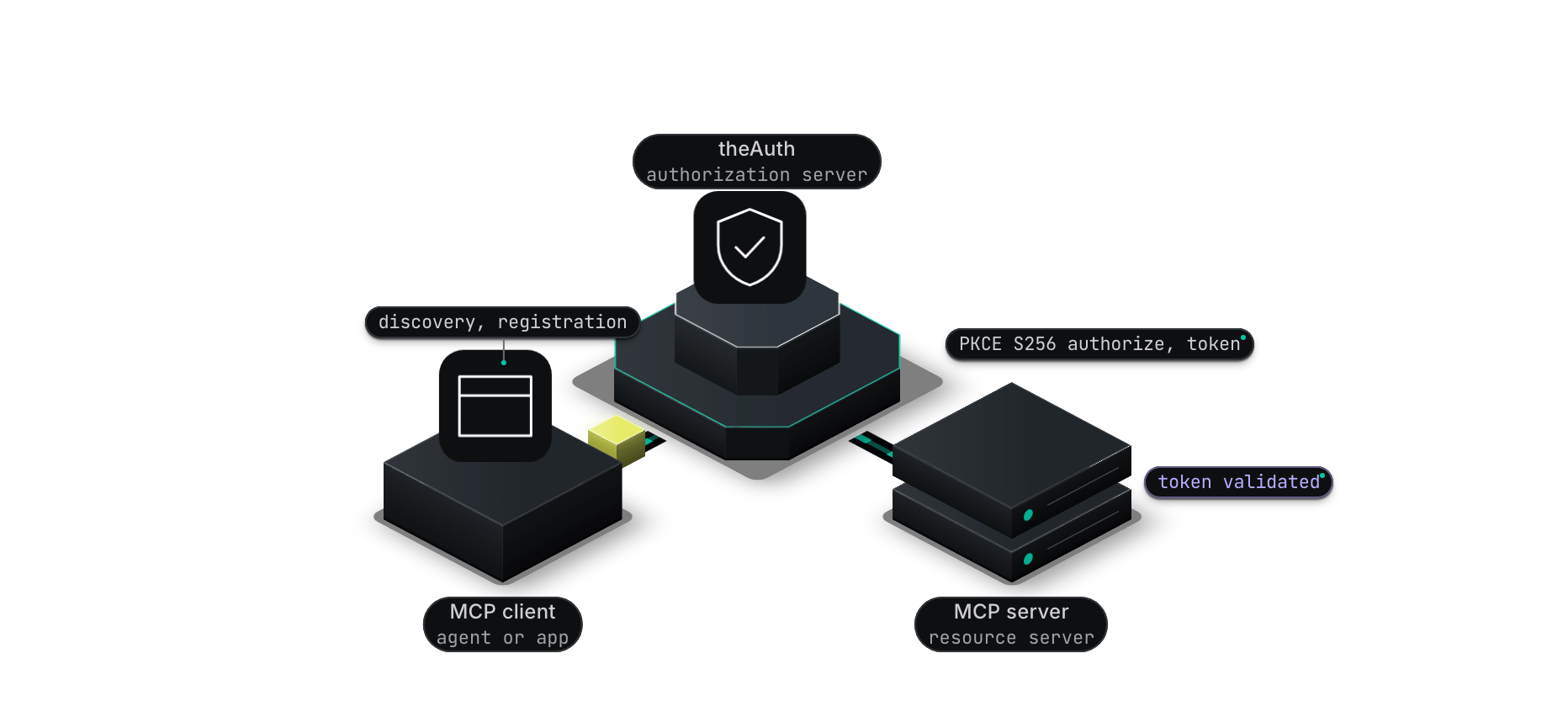
> The Model Context Protocol (MCP) specification (2025-11-25 and the draft revision) mandates OAuth 2.1 with PKCE for any MCP server that exposes tools over HTTP.
The Model Context Protocol (MCP) specification (2025-11-25 and the draft revision) mandates OAuth 2.1 with PKCE for any MCP server that exposes tools over HTTP. The authorization layer is more involved than a typical app-login because the *caller* is an AI agent, not a human, and the chain of delegation must be auditable and revocable at every link.
 ## What the MCP spec requires
1. **An OAuth 2.1 AS** that mints RFC 9068 JWT access tokens bound to a specific resource via RFC 8707.
2. **Agent identities:** Long-lived client credentials for the agents a user trusts (`client_credentials` grant).
3. **Delegation grants:** A user-approved record that lets a specific agent act on a specific resource. Revoking the grant invalidates every derived token at the next introspection refresh.
4. **Token exchange (RFC 8693):** When an agent acts on behalf of a user, the access token carries an `act` claim chain so the resource server can see the full delegation path and reject the request if any link is revoked.
5. **Resource server validation:** The MCP tool server validates tokens, enforces audience binding, walks the actor chain, and emits the correct `WWW-Authenticate` header on failure (RFC 6750 + RFC 9728).
6. **Discovery documents:** `/.well-known/oauth-authorization-server` (RFC 8414) and `/.well-known/oauth-protected-resource` (RFC 9728) so MCP clients can auto-configure.
## How theauth-go covers the spec
```
User browser ----[authorization code + PKCE]----> theauth AS
|
MCP client ----[client_credentials]------------> | (agent self-token)
|
MCP client ----[token-exchange]----------------> | (user delegates to agent)
|
MCP tool srv <---[JWT with act chain]------------- |
|
v (validates via mcpresource middleware)
|-- JWKS verify
|-- audience enforce
|-- act chain walk via introspection
|-- revocation propagate
```
Every step ships in theauth-go:
| MCP requirement | theauth-go component |
| - | - |
| OAuth 2.1 AS | `Config.AuthorizationServer` |
| Agent identities | `Config.AgentIdentity`, `CreateAgent`, `MintAgentCredential` |
| Delegation grants | `GrantDelegation`, `RevokeDelegation` |
| Token exchange | `/oauth/token` with `grant_type=urn:ietf:params:oauth:grant-type:token-exchange` |
| Resource server middleware | `github.com/glincker/theauth-go/mcpresource` |
| Discovery documents | `/.well-known/oauth-authorization-server`, `/.well-known/oauth-protected-resource` |
## The one-import claim
The `mcpresource` module is a separately versioned, zero-dependency Go module. A consumer importing it does not transitively pull theauth core or any storage adapter. This matters for MCP tool servers that are operated independently of the AS.
## Actor chain depth
The RFC 8693 `act` chain is capped at 3 links (configurable via `AgentConfig.MaxChainDepth`, hard ceiling 3). Deeper chains are rejected with `invalid_request: actor chain depth exceeded`. This prevents runaway delegation trees and limits blast radius if any agent is compromised.
## Revocation propagation
When a user revokes a delegation grant:
1. The `delegation_grants.revoked_at` field is set immediately.
2. New introspection calls return `active: false`.
3. The `mcpresource` validator refreshes its introspection cache within `CacheTTL` (default 60 seconds).
4. After the TTL, every request using a derived token returns 401.
There is no immediate token blacklist push; the propagation window is the cache TTL. Operators who need sub-second propagation should set `WithCacheTTL(0)` on the `mcpresource.Validator` and accept the per-request introspection cost.
## Next steps
* [Authorization Server](/go/concepts/authorization-server) - Wire the AS in your application.
* [Resource Server (mcpresource)](/go/concepts/resource-server) - Wire the RS middleware.
* [Guides: Add an OAuth Provider](/go/guides/add-oauth-provider) - Add social login on top of the AS.
This documentation is built and hosted on [Mintlify](https://mintlify.com), a developer documentation platform.
## What the MCP spec requires
1. **An OAuth 2.1 AS** that mints RFC 9068 JWT access tokens bound to a specific resource via RFC 8707.
2. **Agent identities:** Long-lived client credentials for the agents a user trusts (`client_credentials` grant).
3. **Delegation grants:** A user-approved record that lets a specific agent act on a specific resource. Revoking the grant invalidates every derived token at the next introspection refresh.
4. **Token exchange (RFC 8693):** When an agent acts on behalf of a user, the access token carries an `act` claim chain so the resource server can see the full delegation path and reject the request if any link is revoked.
5. **Resource server validation:** The MCP tool server validates tokens, enforces audience binding, walks the actor chain, and emits the correct `WWW-Authenticate` header on failure (RFC 6750 + RFC 9728).
6. **Discovery documents:** `/.well-known/oauth-authorization-server` (RFC 8414) and `/.well-known/oauth-protected-resource` (RFC 9728) so MCP clients can auto-configure.
## How theauth-go covers the spec
```
User browser ----[authorization code + PKCE]----> theauth AS
|
MCP client ----[client_credentials]------------> | (agent self-token)
|
MCP client ----[token-exchange]----------------> | (user delegates to agent)
|
MCP tool srv <---[JWT with act chain]------------- |
|
v (validates via mcpresource middleware)
|-- JWKS verify
|-- audience enforce
|-- act chain walk via introspection
|-- revocation propagate
```
Every step ships in theauth-go:
| MCP requirement | theauth-go component |
| - | - |
| OAuth 2.1 AS | `Config.AuthorizationServer` |
| Agent identities | `Config.AgentIdentity`, `CreateAgent`, `MintAgentCredential` |
| Delegation grants | `GrantDelegation`, `RevokeDelegation` |
| Token exchange | `/oauth/token` with `grant_type=urn:ietf:params:oauth:grant-type:token-exchange` |
| Resource server middleware | `github.com/glincker/theauth-go/mcpresource` |
| Discovery documents | `/.well-known/oauth-authorization-server`, `/.well-known/oauth-protected-resource` |
## The one-import claim
The `mcpresource` module is a separately versioned, zero-dependency Go module. A consumer importing it does not transitively pull theauth core or any storage adapter. This matters for MCP tool servers that are operated independently of the AS.
## Actor chain depth
The RFC 8693 `act` chain is capped at 3 links (configurable via `AgentConfig.MaxChainDepth`, hard ceiling 3). Deeper chains are rejected with `invalid_request: actor chain depth exceeded`. This prevents runaway delegation trees and limits blast radius if any agent is compromised.
## Revocation propagation
When a user revokes a delegation grant:
1. The `delegation_grants.revoked_at` field is set immediately.
2. New introspection calls return `active: false`.
3. The `mcpresource` validator refreshes its introspection cache within `CacheTTL` (default 60 seconds).
4. After the TTL, every request using a derived token returns 401.
There is no immediate token blacklist push; the propagation window is the cache TTL. Operators who need sub-second propagation should set `WithCacheTTL(0)` on the `mcpresource.Validator` and accept the per-request introspection cost.
## Next steps
* [Authorization Server](/go/concepts/authorization-server) - Wire the AS in your application.
* [Resource Server (mcpresource)](/go/concepts/resource-server) - Wire the RS middleware.
* [Guides: Add an OAuth Provider](/go/guides/add-oauth-provider) - Add social login on top of the AS.
This documentation is built and hosted on [Mintlify](https://mintlify.com), a developer documentation platform.